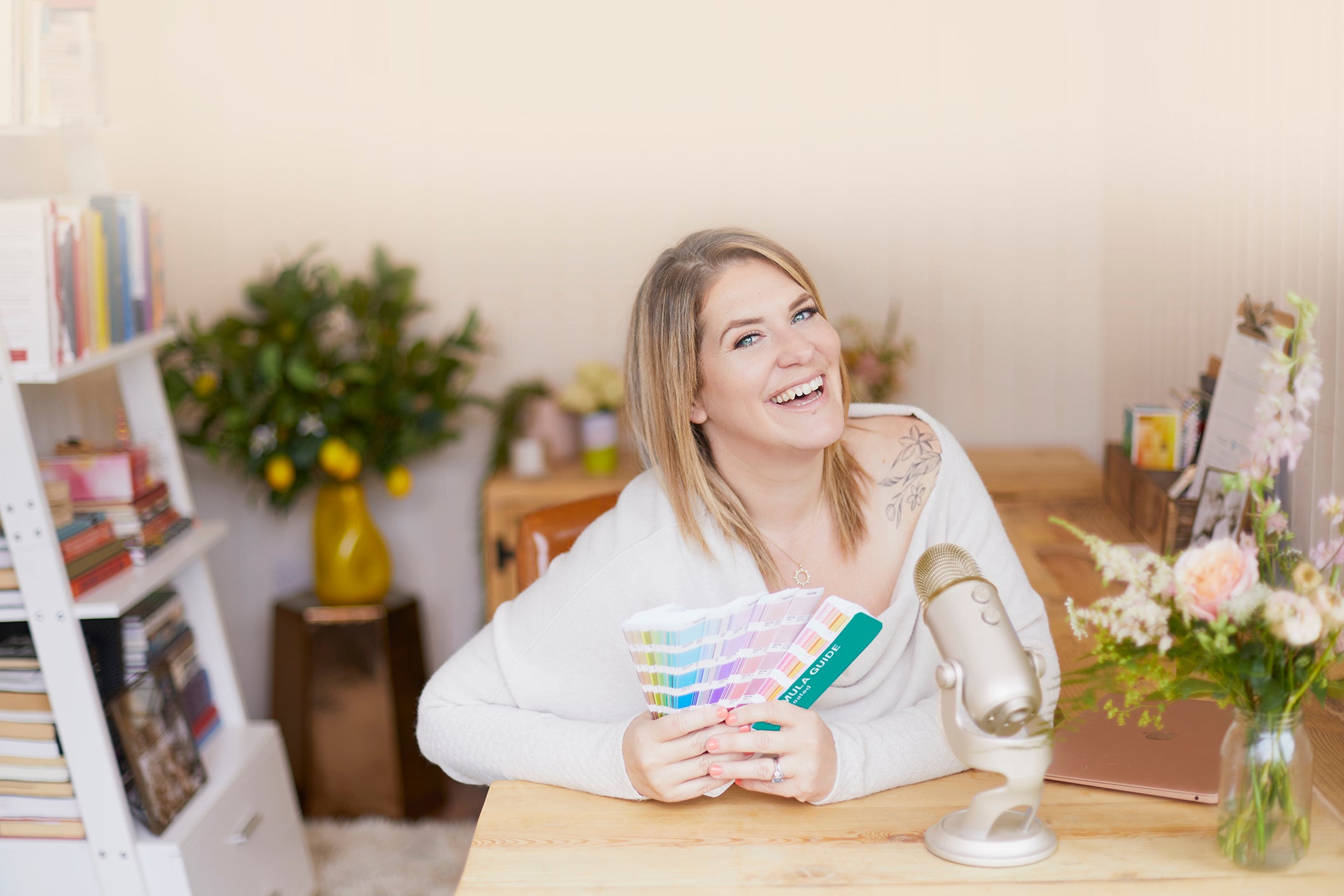


Pantone just named white as their 2026 Color of the Year.
And the internet is... not okay.
TL;DR
When Pantone announced Cloud Dancer (aka: white) as their 2026 Color of the Year, the backlash was immediate. Coming after a year of DEI rollbacks and heightened conversations about white supremacy, the choice definitely felt tone-deaf at best. But is there another side to this story?
In this episode, I dive into:
- The surprising history of Pantone's Color of the Year program
- Who actually makes these decisions (and who has to defend them)
- What colour psychology really says about white
- Whether this was strategic rage-bait for earned media
- What other trend forecasters say we actually need in 2026
- An astrological perspective that shifted my view
Bottom line: This isn't just about colour. It's about who defines the energy of our environments, what counts as "too much," and whether we're brave enough to choose joy in a world training us toward grey.
Coming next week: The Great Grey Down: breaking down 400 years of history, exploring how we lost our color (and how we're going to get it back).
Resources Mentioned:
- Pantone's 2026 Color of the Year: Cloud Dancer
- Pantone Color Institute
- WGSN Trend Report on 2026
- Etsy's 2026 Colour of the Year: Patina Blue
- Natalie MacNeil
- Pinterest Predicts Trend Report
- CNET video featuring Sky Kelly
Ok, You knew this was coming. As soon as Pantone announced their Color of the Year last week, I had to cancel everything and record this podcast because, ooh, wow, there's a lot to say, right? Let's just get straight into it. Here is my take on this controversial Color of the Year from Pantone for 2026.
First, let's remember:
- Pantone is a company
- Cloud Dancer is a marketing decision
- They've got product partnerships and brand deals from Play-Doh to Post-It notes
But they position themselves as more than a company:
- As authorities on colour
- As Cultural anthropologists
- As tastemaker who understand what culture needs
And most especially that colour is never just colour.
- Color is energy
- Color is culture
- Color is identity, politics
- Color is power
So choosing white in this moment, with all its context, with all its timing, is a really strong statement.
Pantone's Official Statement
What Pantone claims Cloud Dancer represents:
- A blank page
- A fresh start
- Clarity
Their official statement (via Leatrice Eiseman):
"The global team at the Pantone Color Institute selected this color for its emotional and creative resonance, not as a statement on politics, ideology, or race. Pantone does not assign political narratives to color. To select or avoid a hue on that basis would give such narratives a significance they do not hold in this process."
My response: Sorry, not buying it.
Here's why:
Can you claim to lead a global cultural conversation in one breath...Then try to run from the culture that colour sits in the next?
They also said:
"Color shifts depending on context and perspective. Cloud Dancer is a color about relaxation, reflection, and creativity. The Pantone color of the year selection process is rooted in an understanding of humanity."
An understanding of humanity, but no political or racial context?
Pretending that in a perfect world, these things don't exist? But they do, and they're driving most of the cultural conversations right now.
The Colour Psychology: Is There Truth to Pantone's Claims?
The question: Is there a basis for this claim about relaxation, reflection, and creativity?
The answer: Yes, there definitely is, rooted in colour psychology.
I also chatted with my friend and mentor, Natalie MacNeil, on this one, and she says that according to astrology, there is additional claim for this, which we will dive more into later (this is what shifted my view).
But my first impression was visceral:
This feels like whitewashing from one of the world's great institutions for colour, which just feels so wrong. If Pantone can't advocate for more colour in a world getting more grey, who the hell can? It feels like giving up, like retreat when what we really need support for is revolution.
After a year of:
- DEI rollbacks
- Mass deportations
- The loudest conversations about white supremacy in decades
It's really hard to imagine how Pantone looked at all of that and said: "You know what the world needs right now? More white."
But diving deeper has shifted my position just a little bit.
I'm looking forward to sharing not one, but both sides of this conversation with you today.
The History: Where Did Colour of the Year Begin?
I cannot think about global colour trends without thinking about that line from The Devil Wears Prada about Cerulean blue: how a few powerful people sitting on the thrones of fashion define an entire year of clothing choices for us normal people grabbing a jumper on sale at TK Maxx or TJ Maxx.
Plot twist: Cerulean blue was actually the first ever colour of the year put out by Pantone in 2000 (six years before The Devil Wears Prada came out).
Why 'Colour of the Year' started:
Pantone had a broader global goal to connect color with culture and 'take the temperature' of the world... finding a colour that expressed the "global spirit"
If that's true, I have to say it does reinforce my concern for this year's colour.
Who Actually Chooses the Color of the Year?
The official answer: Members of the Pantone Color Institute who come from a 'wide range of backgrounds' and communicate throughout the year to analyze and forecast design and colour trends.
The names we can see on the website:
- Leatrice Eiseman
- Laurie Pressman
- Todd Schulman
- David Shaw
- Keith Rekker
- Lan Vu
- Michael Nolte
- Among others
These are the only key people we actually get to see... and they mostly appear to be white folks (let's just put an asterisk on that)...
The process: Described as "color anthropology", they analyze:
- Culture
- Fashion runways
- Films in production
- Museum exhibitions
- Sporting events
- Geopolitics
But Who Has to Defend this choice?
So these people make the decision but these are NOT the people who had to stand on stage and defend this year's Color of the Year.
That was Pantone President Sky Kelley:
Who, by the way, is a Black woman... apparently not involved in making this decision but gets the job of defending it.
Not:
- Leatrice Eiseman (the face of Color of the Year for 25 years)
- Laurie Pressman (the vice president putting out most statements)
The implication seems hard to ignore::
Did they know backlash would include accusations of racism and white-washing so they put their Black president out front to absorb it? "See? A Black woman approved this. So it CAN'T be problematic." 😬
The Rage-Bait Question: Was This Intentional?
At the December 4th launch event, Sky Kelley said:
"When I first learned the color, I thought, 'This is going to be pretty controversial.' But the power of this program, the power of Pantone's Color of the Year is that it sparks a conversation. A conversation about color that everyone can participate in. At Pantone, we don't dictate that conversation, we facilitate it."
So let me get this straight:
They KNEW it would be controversial. They KNEW people would be upset. They chose it anyway...
This means: They watched all of 2025 unfold, the DEI rollbacks, the immigration policies, the political climate and thought: "Yeah, let's go with white."
What Pantone stands to gain:
- Earned Media - They're in EVERY major publication (millions in free publicity)
- Relevance - Since they're no longer part of Adobe palettes, they need cultural relevance
- Product Sales - All those partnerships are already contracted and shipping
- No Accountability - They can hide behind "it's just color" forever
Isn't this the Sydney Sweeney American Eagle playbook?
- Choose something you KNOW will upset people
- Act surprised when it does
- Position controversy as "facilitating conversation"
- Profit from the engagement
What Do We Actually Need Right Now?
According to Pinterest Predicts (analyzing 5 billion searches):
The top trends for 2026 reveal three major themes:
1. Nostalgic Escapism (Innocent Arachetype vibes)
The data:
- 52% of respondents are rewatching classic TV or films
- Nearly 40% are cooking or eating traditional comfort foods
- Nostalgia is evolving into reclamation: fusing past with present to brace for the unknown
- Comfort is the primary emotional need (55% prioritize it daily)
- Safe havens and everyday rituals
- Using nostalgia to feel like themselves again
Colors for emotional comfort:
- Soft pinks
- Peaches
- Light, gentle yellows
- Anything from your youth that fills you with nostalgia
- Anything that feels retro in a positive way
Typically, innocent colours are soft, light, pastel-y, and gentle.
2. Creator/Explorer Energy: Curating, Not Copying
The data:
- 42% of global respondents say they only participate in trends that suit them
- Mismatched manicures, two-tone lipstick, bright eyeshadow
- Goodbye to symmetry
What this signals:
- Moving away from perfection
- Rise of unpolished content
- Emphasis on going your own way and having fun with it
- Not worrying about what other people think
This is a mixture of:
- Explorer energy (freedom, your own path)
- Creator energy (making something new)
- A little bit of Rebel (breaking conventions)
Why this matters:
- Creativity and anxiety cannot exist at the same time in your body
- Using creative energy is how we survive these times
- Engaging that part of your brain more is such a useful way to feel better
3. Grounded Optimism: The Five-Year Plan Is Dead
The data:
- Most consumers can't envision a future beyond 24 months
- People are seeking grounded optimism in the present
- Escapism is their emotional fuel
What's bringing people joy:
- Escapism
- Re-engaging with nature
- Self-care
For younger generations:
- Gen Z respondents are 38% more likely to say they've embraced self-expression to stay emotionally connected and creatively fulfilled
Colors for this energy:
- Orange
- Yellow
- Whatever the hell brings YOU joy
- Whatever makes you feel self-expressed
- Whatever you want in any given moment
This doesn't have to mean buying stuff—it can just mean choosing colors that express you more.
What Colours We Actually Need Right Now
Based on all of this, here's what I recommend for 2026:
Grounding colors:
- Warm browns
- Terracotta
- Rust
- Olive greens
Connection colors:
- Anything with pinks
- Warm corals
- Salmon pinks
Energy colors:
- Anything really bright and electric
- Colors that make us feel good
Nature colors:
- Greens and blues
- Things that connect us with the natural world many of us are turning to right now
The Astrological Perspective: What Changed My Mind
This is the part where my opinion shifted.
My friend Natalie MacNeil shared an astrological perspective with me:
According to many, many modalities and energetic systems from numerology to gene keys to astrology, and many more, we are coming to the end of many cycles. This 'ending' energy is a great fit for the ways Pantone is describing 'cloud dancer' - moving towards a 'clean slate' or a fresh start.
Natalie's insight: She believes 2027 will be the time where we energetically step into new cycles and start drawing on that blank canvas. That all our 'joyful colour' will be a big part of the 2027 conversation.
Only time will tell...
But in the meantime as we deal with all this 'extinction burst' energy, the darkness and shadows emerging and running amok...
There's a strong argument for white as an emotional cocoon:
- When we have all this overwhelm
- When we're craving simplicity
- It can bring that "quieting the noise" sensation
I am definitely all in for going white over grey:
- There ARE positive psychological benefits of white (though not in huge amounts)
- But choose a white that suits your personality type
- By default warmer whites are better to spend time in than cool ones
Why warm white matters: Surrounding yourself with cold undertone whites as we move into winter, when the light outside is already gray and dark, is NOT a good recipe for a happy, healthy mind and nervous system.
So maybe:
- This IS a time to look at simplicity
- To shed what's not working
- To prepare
- To sit quietly with everything that's going on
My Final Take: Both/And Instead of Either/Or
Here's what I landed on:
Yes, we're exhausted. Yes, we need simplicity.
But:
Exhaustion doesn't just need nothingness and noise-canceling headphones (though I'm a fan of both).
It also needs:
- Grounding
- Warmth
- Connection
We don't just need to escape:
- We need to feel held
- We need to be there for each other
- Rather than cocooning ourselves in isolation
My Advice for Your 2026 Color Choices
For your own brands, wardrobe, home, and spaces:
Ignore the trends. Listen to what your body wants and what your heart is craving.
Give yourself permission to pursue it.
Stop quieting or ignoring that voice:
- Tune in more often
- Listen more intently to what you are craving
- Remember that color can be an incredibly useful tool to provide what you seek
- It's such a good starting point for feeling better, especially if you're feeling tired and overwhelmed
And no, I would not suggest that white is going to be the greatest starting point for that journey.
Coming Next Week: The Great Grey Down
Next week, we're going to explore the historical context of what makes Cloud Dancer both a controversial and an inevitable choice.
Many of you have been sending me the content that's been going viral, claiming our man-made world is getting less colourful. Is it true?
Next week we'll dive in and explore:
- The 400 years that have led to this great grey down
- How and why we lost our colour
- How we're going to get it back
Share This Episode
If this episode made you think differently about colour (or confirmed what you already suspected), or if you just plain thought it was interesting, please share it with someone who:
- Needs more colour in their life
- Has strong opinions about colour
- Is tired of beige everything (or needs a neutral wake-up call!)
I hope our conversation today helps you find, choose, and share more joy today and throughout this week.